
The small PD giant
PD (Democratic Party), later known as PDL (Democratic Liberal Party), was a party in Romania with an interesting political trajectory. It marked the Romanian political scene from 2004 to 2014 and served as a platform or vehicle for many well-known politicians in post-communist Romania.
Born out of divisions within the FSN (National Salvation Front) and dominated by figures such as Petre Roman, Traian Băsescu, Emil Boc, and Vasile Blaga, PD was one of the very few parties that radically changed its ideology during its existence. It went from being a small party in the 1990s to the party that came close to defeating the PSD (Social Democratic Party) in 2008.
After the successful years of 2004-2008, PD’s decline began, and it eventually became PDL. This decline culminated in the absorption of the party by the PNL (National Liberal Party), with the remnants of PD-PDL remaining as a kind of hidden alter ego of the PNL.
The “birth” of PD took place in 1992 and was caused by divisions within the FSN. At that time, FSN dominated the political scene of the 1990s. The party had two major dominant figures: Ion Iliescu and Petre Roman. These two represented different segments of the former communist apparatus. Iliescu represented the older generation, educated either in Romania or in Moscow, who advocated for a “human-faced” communism and perestroika but still supported state control over the economy. On the other hand, Petre Roman was younger and had studied in the West, making him more liberal and reform-oriented.
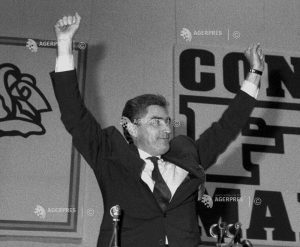
The tension between Iliescu and Roman increased over time, especially after the 1991 miners’ riot when thousands of miners stormed institutions in the capital and demanded Roman’s resignation as prime minister. Meanwhile, Alexandru Bârlădeanu, the Senate President, declared that Roman had resigned (even though he had not), showing the tacit approval the faction of former communists led by Iliescu had given to the miners for overthrowing Prime Minister Roman.
In March 1992, the National Convention of FSN took place, and Roman was elected as the president of FSN. In reaction, Iliescu and all his supporters left the party and founded a new party, FDSN (Democratic Front of National Salvation). The remaining FSN kept Petre Roman as its president, changed its name to the Democratic Party in 1993, and adopted a center-left social democratic position.
Thus, PD was born, and its long presence in Romanian politics began. In the next round of elections, PD obtained 10% of the votes and went into opposition, and in 1996, its support increased to 13%.
In 1996, PD signed an agreement for electoral and governmental cooperation with CDR (Democratic Convention of Romania), an alliance of opposition parties that went on to win the 1996 elections and come to power. Alongside CDR, PD joined the government, holding several ministries, with the most notable being the Ministry of Transportation led by a young man named Traian Băsescu, a former sailor with a distinctive hairstyle to mask his baldness.
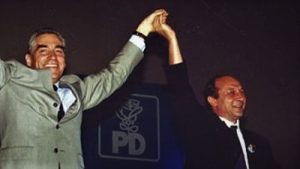
PD was a challenging partner for CDR, as it was a left-leaning party in a coalition of right-wing parties. PD also criticized the activities of ministers from other parties and destabilized the alliance through constant threats to withdraw from the government.
After the years of CDR’s government, the coalition disintegrated, and PD moved forward. In the 2000 parliamentary elections, PD obtained around 7% of the votes, and its candidate for the presidential elections, Petre Roman, received a poor 2% support, indicating a decline in his political star that had shone in the 1990s. During this time, Traian Băsescu, the than mayor of Bucharest, gained more influence and eventually replaced Roman as the party’s leader.
After four years of PSD’s (Social Democratic Party) unchallenged rule under Adrian Năstase, the two major opposition parties, PNL and PD, joined forces to form the DA (Justice and Truth) Alliance for the presidential and parliamentary elections. Initially, the presidential candidate was Theodor Stolojan, but unexpectedly, he withdrew, and in a moment known as a meme in Romanian politics, Băsescu literally cried on Stolojan’s shoulder and offered to run for president on behalf of the Alliance.
The DA Alliance won over 30% of the votes in the elections and formed the government, with Băsescu becoming the president. However, due to disagreements within the coalition and the dismissal of some PD ministers by Prime Minister Tăriceanu, the alliance broke apart in 2007. Also, in an apparently strange move, after Roman’s departure, the party began to shift more towards the right, officially adopting a Christian democratic liberal-conservative ideology in 2005, making a definitive transition from a firmly left-wing party to a right-wing one. This was an apparent bizarre and rare occurrence in both Romanian and European politics.
While the PNL-PD government was in power, a group within PNL centered around Stolojan left the party, forming the PLD (Liberal Democratic Party). In 2008, PLD and PD merged to form a new right-wing party, the Democratic Liberal Party (PDL).

Shortly afterward, parliamentary elections were held, and PDL, led by Emil Boc (though Traian Băsescu was the de facto leader), obtained a score of 33% and unexpectedly entered the government with the PSD, the party that won just 1% more and was, in fact, the old FDSN of Iliescu, albeit having undergone a couple of name changes in the meantime.
However, after a year in government, the alliance collapsed, and Emil Boc’s government was dismissed. Also, in 2008, the dark clouds of the economic crisis began to gather. After forming an alliance with other small parties to create a government, Boc returned as prime minister, being strongly influenced and “guided” by Băsescu.
In 2009, the economic crisis intensified, and Băsescu faced Mircea Geoană in the presidential elections. After initially appearing that Geoană would win, Băsescu secured another term as president.
As the economic crisis deepened, the popularity of PDL declined. After the PDL government decided to cut pensions and salaries, the support for PDL, Boc, and Băsescu plummeted. PNL and PSD took advantage of this wave of indignation and formed the USL (Social Liberal Union), a vehemently anti-Băsescu and anti-PDL alliance.
PDL also allied with a few other small parties and created the ARD (Right Romania Alliance). In the 2012 elections, PDL suffered a heavy defeat, and USL won an impressive 62%, installing Victor Ponta as prime minister, who became the “new hope” of PSD and a political disciple of Adrian Năstase.
In this situation, with Băsescu forced to coexist with a parliament that was openly hostile to him and with PDL scoring not much higher than PD did in 1996, PDL seemed to be in a deadlock. It was increasingly isolated in the parliament.
Another event that marked PDL was a rupture between Băsescu and the party. Until then, he had always had a significant say both in PD after 2000 and in PDL. The two were seen by the public as “Băsescu’s Party,” but in 2012, Băsescu tried to impose his close associate and protege, Elena Udrea, as the party’s leader. However, the party refused and chose Vasile Blaga as the new leader. This led to a rupture between Băsescu and the party.
As a result of these divisions and the downward trend it was experiencing, PDL allied with PNL (National Liberal Party) for the 2014 presidential elections under the ACL (Christian Liberal Alliance) and began discussions about merging the two parties.
Also, in 2014, PDL was officially absorbed by PNL, and to this day, former PDL members such as Emil Boc, Gheorghe Flutur, Vasile Blaga, and many others remain a distinct and influential group within PNL.
However, not all of PDL accepted this merger with PNL, and Traian Băsescu and other close associates, such as Elena Udrea, broke away from PDL and formed the PMP (People’s Movement Party), a more conservative rip-off of PDL, which truly became “Băsescu’s Party” this time.
PMP entered parliament in 2016, barely meeting the electoral threshold, and among others, sent Băsescu to parliament as a senator.
In the 2019 European Parliament elections, PMP managed to pass the electoral threshold and sent some MEPs to Brussels, with the most prominent being, of course, Traian Băsescu.
In the 2020 parliamentary elections, PMP narrowly missed entering parliament.
In conclusion, whether called PD or PDL, this party had a unique and dynamic career on Romania’s political scene. It started as a small party resulting from what was then a major split in Romanian politics and initially had a small but consistent presence. It later became a major player that influenced Romania’s future and consecrated many politicians, some more or less corrupt. After its years of relevance, it fell into irrelevance and eventually disappeared as a party, but its members did not vanish, as many of them continue to be active in politics today.
Bibliography:
https://youtu.be/MMl331qCVtY
https://youtu.be/uUbN6DXJwFg
https://youtu.be/sVpJX3h9OTA
https://youtu.be/1Rk4YzxyV9A
https://youtu.be/1Rk4YzxyV9A

Bizarul Silvio


