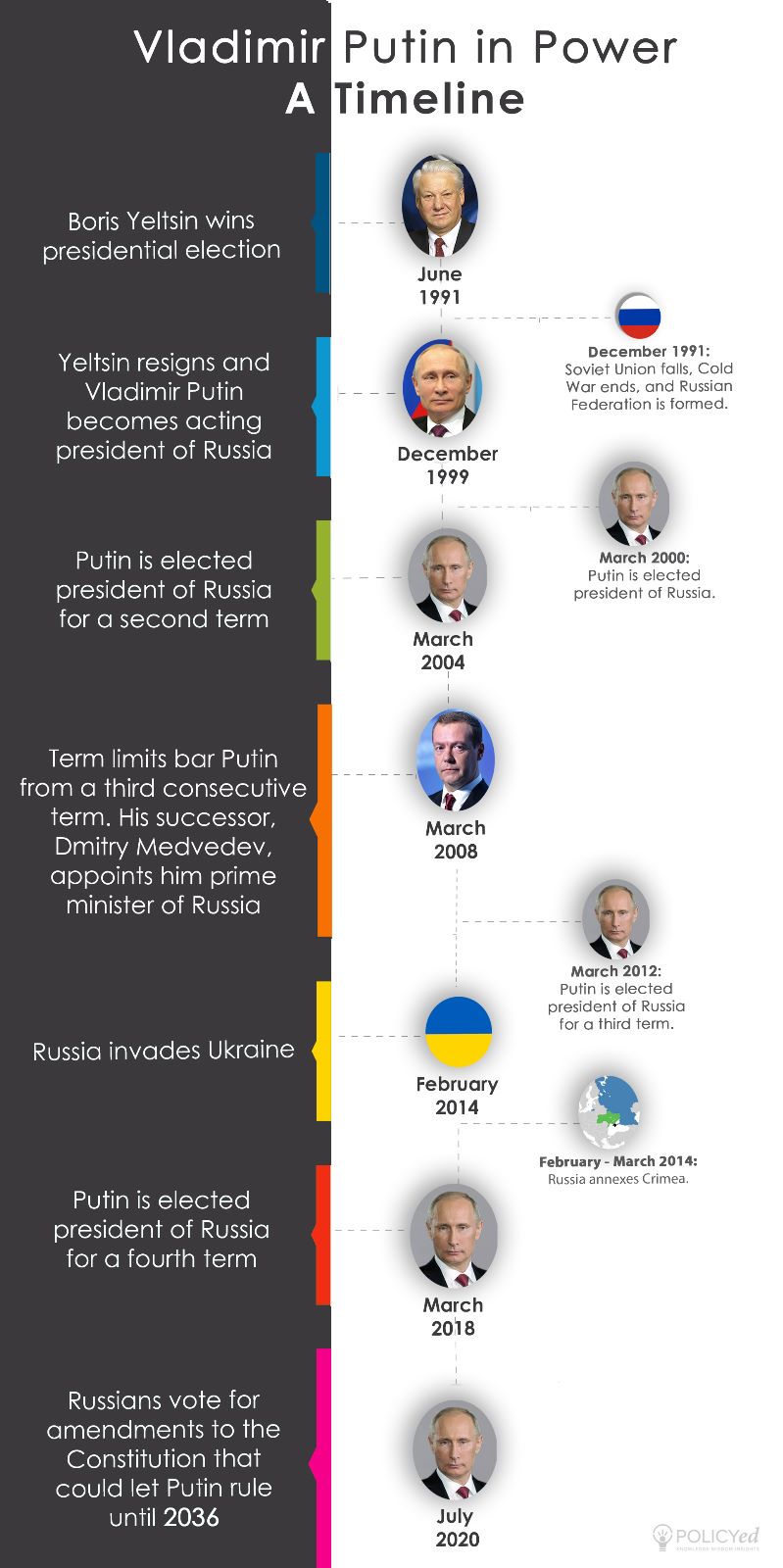
1+1+1=2,5 the math of the Russian Presidents
When it comes to the position of the president of Russia, the world’s mind goes to Vladimir Putin, de facto president since 2000 and official president from 2000 to 2008 and from 2012 to present (and well into the future). Everyone’s mind goes to this stiff-handed bare-chested rider when it comes to this position.
But what many people either forget or don’t know all together is that there were two more presidents of Russia between 1990 and today: Boris Yeltsin and Dimitri Medvedev, each with their own personality, achievements and failures.
The first president of Russia was Boris Yeltsin, elected relatively democratically in 1990 to the position of head of the Russian Soviet Federal Socialist Republic, a position from which he began to undermine the authority of the reformist leader of the USSR, Mikhail Gorbachev. From this position, Yeltsin consolidated his power and contributed alongside other leaders of therepublics that were part of the USSR, to the dissolution of the union, which was already inevitable.
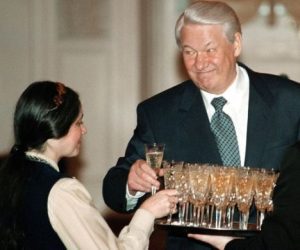
After the fall of the USSR, Yeltsin remained the president of Russia, being responsible for the transition from a communist economy to a capitalist one, which, with all the corruption, led to the emergence of oligarchs – people often of a questionable character who seized the old communist factories and built corrupt business empires.
Although initially the position of president was not very strong, after a constitutional crisis in 1993, in which Yeltsin fired the cannon, both literally and figuratively in the authority of the parliament, a hyper-presidential regime was imposed, in which he would have vast powers and be able to massively influence the government, the parliament and the judiciary system. Yeltsin established a presidential dictatorship in Russia, creating an institution with extensive and almost uncontrollable powers. This institution will be very useful to Putin, who will increase the power of the presidency even more.
His period is dominated by corruption, poverty and economic collapse, with Russians still deeply marked by the chaotic 90s, years they rightly associate with Boris Yeltsin. On top of all the economic problems and the organized crime that had begun to grow stronger, was also the fact that Yeltsin was an alcoholic, which reduced his leadership capabilities even more. This led to numerous incidents where he was drunk at public events, making Russians feel ashamed of their own state and its leadership.
After the 1993 moment, an increasing regime with authoritarian overtones, but which was still essentially democratic was gradually installed in Russia. A system of oligarchs, corruption and organized crime was established, but Russia was not a dictatorship. One could still speak freely, the press was uncensored and the judiciary still had little twitches every now and then, occasionally investigating certain corrupt officials, actions often stopped by blackmail.
Moreover, Yeltsin had to face elections in 1996, when by using the already rotten system, he managed to be re-elected. After ’96, his already dying reforming spirit perished, and he gavemore and more power to the oligarchs, becoming weaker by the day. His health was deteriorating, the country was in economic agony and the oligarchs were scared for the future of their businesses.
Yeltsin had failed and Russia’s first decade of democracy was coming to an end, most people lived in abject poverty, corruption was endemic and crime was out of control.
In 1998, obeying a proposal of the oligarchs, Yeltsin appointed an unknown former KGB officer, Vladimir Putin, as prime minister. Putin spends a short time as prime minister, during which he strives to create the image of a strong and authoritarian man who will restore Russia’s lost greatness.
On December 31, 1999, in his New Year’s message, Yeltsin resigns as president, apologizes for his failure and named Putin as his successor. The latter automatically becomes the acting president of Russia. Presidential elections followed in 2000, with Putin winning the first round with 53% of the vote, and thus the Putin Era begins.
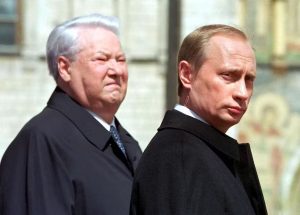
He quickly began to consolidate his power, destroying with a surprising ferocity the free press, assassinating the opposition and turning the laws into weapons of his dictatorship. He also closed ranks with the oligarchs, not stopping organized crime, but making it less violent towards the population. Moreover, he made some economic reforms, which coupled with the global increase in gas prices led to an economic recovery, leading to an improvement in the country’s situation.
In his first Years in power, Putin was an open and even friendly towards the West, collaborating with NATO and the EU, which led to a greater economic integration with the West and increasingly strong ties, conferred by the EU’s massive purchase of Russian gas.
But soon after Putin got used to the position of president, he had to leave it. The Russian Constitution states that no person is allowed to serve more than two consecutive presidential terms, thus placing no limit on the total number of terms. So in 2008, Putin could not run again.
He gave the position to Dimitri Medvedev, an obedient ally who would step out of the ranks. The elections were just a formality, with Medvedev being elected in the first round and Putin once again taking over as prime minister. Although the new leader had moments when he succeeded in imposing his own will, he never outgrew his role of a puppet president.
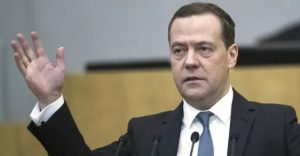
Medvedev was given the freedom to act according to his own plans, even though sometimes it was contrary to what Putin wanted, but it was all just to be more convincing when he said that he was not just a puppet of the current prime minister.
In some cases, Medvedev has been even more open towards collaboration with the West than Putin, but despite some moments of relative rebellion, Medvedev has always remained obedient to Putin, never forgetting that his real role is to keep the boss’s seat warm.
As his term drew to a close, Medvedev announced early on that he would not run again. In 2012, Putin was re-elected easily, and his loyal pawn became prime minister.
After his return in 2012, Putin took a more aggressive and conservative stance, no longer being the same friendly and non-imperialist leader. Since then his rhetoric has become increasingly aggressive. Not only the rhetoric became aggressive, but also the military actions, with Russia annexing Crimea and invading Ukraine in 2022.
Meanwhile, Putin has also taken care of the restrictions in the Constitution and he reigns unhindered and will probably reign as Russia’s new Tsar until death if the people don’t stop him.
But Russians seem to mostly support him sincerely, and those who don’t are silent out of fear. A popular overthrow of Putin by Russians is unlikely, as they feel he is the strong man who willmake Russia respectable again and, most importantly, they see him as Yeltsin’s opposite. If Yeltsin was drunk and weak, Putin is macho, sober and full of authority. This image did not only arise from the perception of the Russians, but was also maintained by Putin through propaganda and all kinds of photo shoots or so-called “spontaneous events”, in which he played the role of a strong and vigorous man who is good in everything.
In short, this is the story of the 2.5 presidents of Russia. It is probably already obvious why they are considered 2.5 and not 3 leaders. But for those who are still wondering, the reason is simple: Dimitri Medvedev was never in control of his own presidency, being essentially a puppet ofPutin. The only reason Medvedev was president where the restrictions regarding the current leader in the Constitution. This was part of a change of places designed to preserve Vladimir Putin’s power, a play in which Medvedev played his role well, being an instrument in the perpetuation of Putin’s dictatorship.
Extra info:
https://www.youtube.com/watch?v=lxMWSmKieuc&t=195s
https://www.youtube.com/watch?v=jAsqtldf5o8&t=1017s
https://www.youtube.com/watch?v=kHgI6um1BMc
“Let’s talk about Putin! What the West doesn’t understand” – Mark Galleoti


