Union with Moldova: an old and natural ideal, but at present, impractical and unfeasible
Lately the subject about the Republic of Moldova has become again very debated, the band Zdob and Zdub had a very good performance at the Eurovision Song Contest and performed a song with a strong unionist message, Moldova has obtained the status of a candidate country for the EU membership and the Parliaments of our countries had a joint meeting.
These events brought back to the public’s attention the prospect of reunification with Moldova after over 70 years of forced separation. But from my point of view, a union with the Republic of Moldova at the moment becoming impractical and risky, due to an accumulation of political, social, diplomatic and bureaucratic factors.
First of all, a union with Moldova would lead to an influx of Russian-speaking and Russophile populations.
Moldova has a significant ethnic Russian population that has a native pro-Russian inclination, which is contrary to the interests of Romania and Moldova. In addition to ethnic Russians, east of the Prut there is a significant number of Russophile citizens, who reject the liberal ideas of the EU, supporting the ideas promoted by Putin’s dictatorship in Russia. A union with Moldova would therfore lead to a significant increase of Russophiles in Romania and the emergence of an ethnic Russian population that serves Moscow’s interests and may serve as a pretext for aggression from Russia.
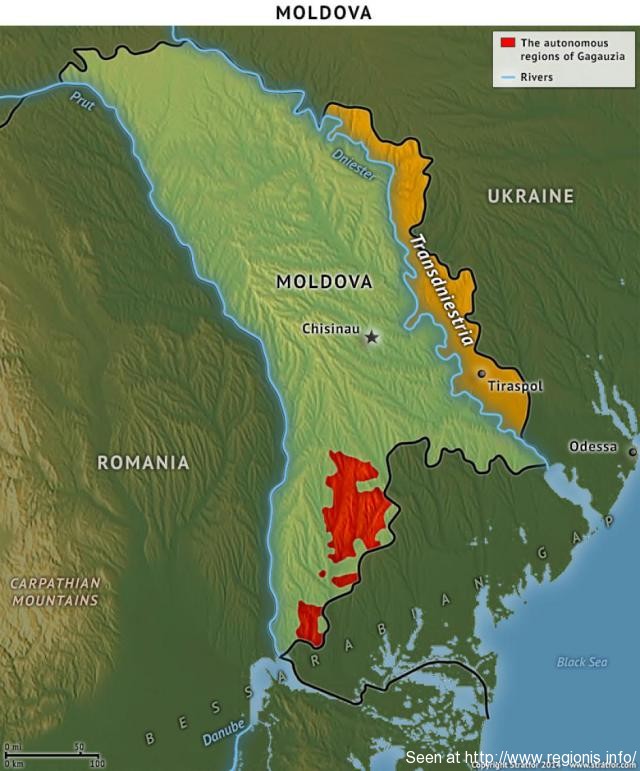
Together with the population of Russophiles and the Russian-speaking population come two more special territories. Currently, Moldova has two separatist regions on its territory, Transnistria and Gagauzia. The first, Transnistria, is a ghost state with its own parliament and Russian “peacekeeping” troops (aka “little green men”) on its territory. This region makes it difficult for Moldova to join NATO and the EU and would put a new Greater Romania in a very delicate situation, since we would hypothetically be a NATO member country with Russian troops on its territory and a frozen conflict ready to “melt” whenever Russia wants it to.
The other one is the relatively unknown Gagauzia, a territory populated by the Gagauz, a people of Turkish origin (even if for some the term “Gagauz” sounds more like an insult than an ethnicity since in Romanian “gagauta” means “idiot, stupid”). Although this province s not a ghost state like Transnistria, it still has a pro-Russian orientation and would put Romania in a difficult situation.
Another very complicated aspect of the union with Moldova is represented by the fact that the Moldovan state apparatus must be integrated into the Romanian one. Many institutions should be abolished or merged with existing ones, the number of MPs must be increased and representation for the Moldovan parliamentary political forces must be ensured. New regional branches should also be established and officials of the Moldovan state system should be integrated into the Romanian one, which would lead to an even greater increase in the number of state officials, a figure already too high in Romania. Moreover, the Moldovan state apartus has some incompetent officials or political appointees, and a merger between the two states will also increase the number of such officials.
Along with the above-mentioned Russophile population, there are also Russophile political forces such as the Communists and Socialists Block (BCS) and the ŞOR Party. These political forces are currently doing everything possible to stop Moldova’s European path. And these political forces will now operate nationally in Romania and make formal or informal alliances with other Russophile political forces in Romania (probably formally with AUR, and informally with PSD)
Last but not least, from an economic point of view, Moldova’s integration into Romania would not be of much help, since Moldova has a GDP similar to that of Prahova County. The Republic of Moldova is one of the poorest countries in Europe, with underdevelopment being a dominant problem of the state.
By uniting with Moldova, we could get a few more good vineyards, but we would add to the country a poor and poorly developed territory with no infrastructure, something that would take us even lower in the rankings of living standards and economic conditions.
Thus, there is still a long way to go before we unite with Moldova, this being a long and complicated process. The Moldovan state has many changes to make and many problems to solve until it is ready for a smooth union that does not destabilize the newly formed country. Until then, both countries must make efforts to improve living conditions and modernize everything related to their own territories.


